What Is MFTE? And Does It Actually Work in Washington State?

As far as I am concerned, MFTE is one of the most debated tools in Washington housing policy. Why? Well, cities want more affordability for every dollar exempted, developers see it as a way to get buildings financed, and critics point out that the exempted taxes shift to other property owners.
But before we get into that discussion, let’s start out with what it is.
What MFTE is
MFTE stands for the Multifamily Property Tax Exemption. The Legislature created it in 1995 (under RCW 84.14) to steer growth into city centers under the Growth Management Act. Cities and counties – about 60 Washington jurisdictions in all (Department of Commerce) opt in, draw "residential targeted areas," and then offer developers a deal: build multifamily housing in these locations and the new units are exempt from property tax for a set period.
A few points to remember though:
1. Land is still taxed. The exemption covers only the value of the new residential construction, not the land or any commercial space in a mixed-use building;
2. It is temporary. When the exemption ends, the full assessed value comes back on the tax rolls; and
3. It is local. The state sets the floor, but the city decides whether to offer MFTE, where the development has to be located, and how strict it has to be to meet the exemption.
The state law offers three main versions today:

* - A 2021 change also lets cities extend an expiring 12-year exemption for another 12 years, as long as the building keeps affordable units
How it pencils for a developer
For a developer, MFTE is a straightforward trade: property tax saved versus rent given up.
But let me be clear, the decision is purely a math equation – investors will not accept a lower yield just to participate.
Here is a simplified, illustrative example for a 200-unit, 12-year project:
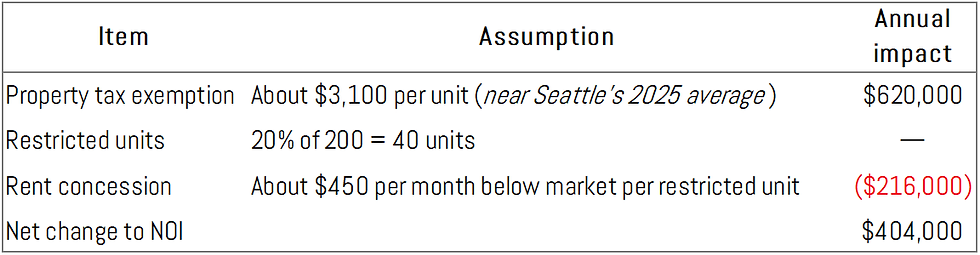
That roughly $400,000 lift to net operating income improves yield-on-cost and can be the difference between a deal that pencils and one that does not.
But it also explains the two blind spots that I see in the MFTE program:
1. It favors small units. Construction cost scales with square footage, but the allowed rent on a two-bedroom does not keep pace, and Seattle proves this: 87% of units in its MFTE program are studios or one-bedrooms; and
2. It favors mid-rise wood frame construction. Developers see the program working for five- to eight-story podium buildings, but rarely for high-rise developments where costs are significantly higher and the math simply fails.
I would add that every time a city deepens the affordability requirement, the rent concessions grow and the program gets closer to break-even. At that point developers simply stop applying.
What the evidence says
The best data we have shows MFTE delivers real units and real rent discounts, but the public gets back roughly 50 cents in rent savings for every dollar of tax exempted.
Production is significant. Statewide, MFTE supported 8,102 new units in 2025 across 24 jurisdictions, of which 1,530 were rent-restricted. Commerce estimates MFTE was used for about 30% of all new multifamily units in Washington over the past two years. In Seattle alone, the program has supported nearly 34,000 units since 1998, about 7,000 of them income-restricted.
Whether it creates net new housing is harder to prove. The state's 2019 JLARC review called the net production effect inconclusive. The 2024 UW evaluation concluded the effect is positive but impossible to measure precisely. It found the clearest impact in small units, where an MFTE-fueled building boom helped push studio rents down after 2019.
The rent discount depends on location. Inside the same building, Seattle MFTE studios and one-bedrooms rent 15% to 30% below unrestricted units. Compared with the wider market, the gap shrinks. In lower-cost areas such as Rainier Valley, MFTE rents can match or exceed nearby market rents, which means little public benefit.
It is not deep affordability. About 85% of Seattle MFTE tenants are still cost-burdened, spending 30% or more of income on housing. That is by design: rents are set near 30% of the maximum allowed income, so anyone earning less pays more than 30%.
The cost lands on other taxpayers. Because Washington levies are capped, an exemption mostly shifts taxes to everyone else rather than cutting city revenue. UW estimated almost $80 million shifted in Seattle in 2024, roughly $130 a year for a median homeowner, plus about $35 million in truly foregone revenue from how MFTE buildings are assessed.
The value-for-money ratio depends on the rules. UW compared rent discounts to tax exempted in Seattle. Older program versions returned 46 to 50 cents per dollar. The stricter 2019 rules returned 78 cents, but developers said those rules pushed the deal close to break-even.
What changed in 2025
MFTE is moving in two directions at once: more generous near transit, and recalibrated in Seattle to bring developers back.
• 20-year exemptions near transit. The 2025 Legislature added a 20-year exemption for rental projects in light rail and other station areas that commit to long-term affordable or workforce housing, per the Department of Revenue.
• Softer penalties, more counties. Cities can now impose sliding-scale penalties instead of canceling an exemption for noncompliance. Large counties may now offer MFTE in unincorporated urban growth areas.
• Seattle's Program 7. Seattle's seventh version took effect November 14, 2025. It raises allowable rent and income limits, pushes for more two-bedroom units, simplifies tenant income recertification, and cuts the application fee. (Details are on the city's P7 page.)
• Some cities are pulling back. Bremerton eliminated its 12- and 20-year options in September 2025, keeping only the 8-year program.
Compliance also looks better than its reputation. Commerce's statewide monitoring in 2024 and 2025 found no significant wrongdoing and recommended no penalties.
The verdict: does MFTE work?
MFTE works as a production and workforce-housing tool. It does not work as a substitute for subsidized housing for very low-income households, and it was never designed to be.
The program's real value today is keeping marginal projects alive. With high rates and construction costs, a tax break that lifts NOI by several hundred thousand dollars can decide whether a building gets financed. Washington needs that supply. Every unit built, restricted or not, eases pressure on rents somewhere in the market.
The weakness is calibration. Set the rules too loose, and taxpayers pay for discounts that barely exist in lower-cost neighborhoods. Set them too tight, and developers walk away, producing neither affordable units nor market-rate supply. Cities should set clear production goals and adjust the dials, AMI levels, set-asides and unit mix, as market conditions change.
Comments